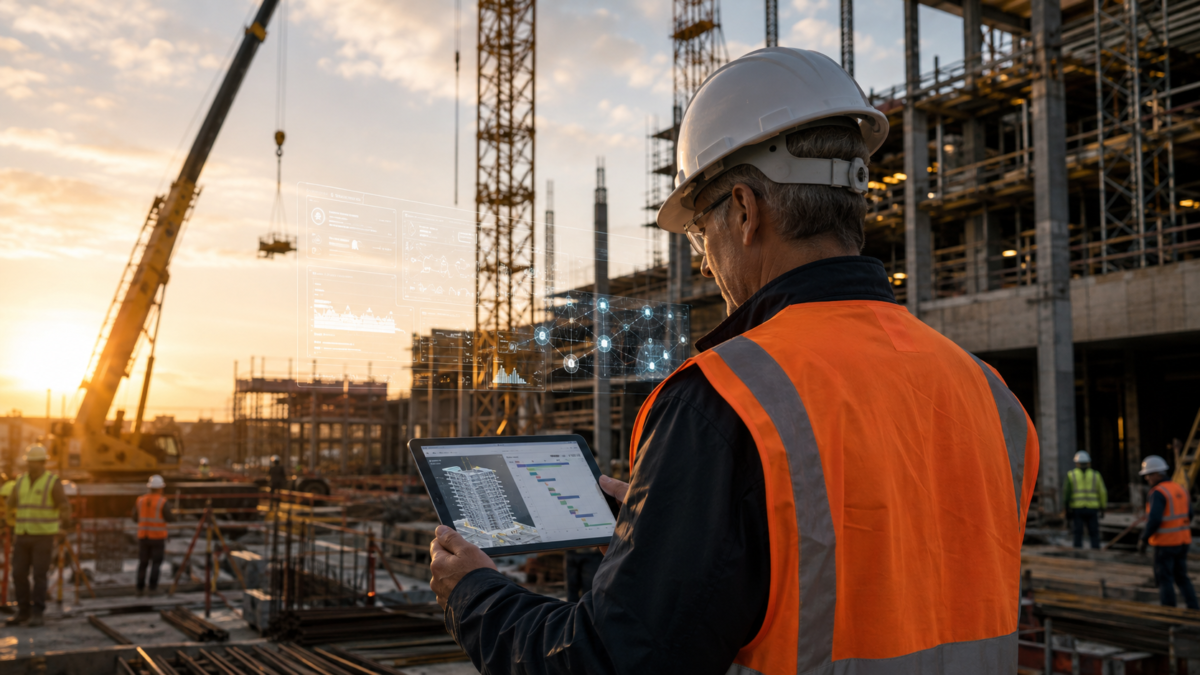
Artificial intelligence in construction is transforming planning, Primavera P6 scheduling, BIM coordination, safety, progress monitoring, delay analysis, and project reporting. Learn the practical benefits, risks, and responsible steps for implementation.
Artificial intelligence in construction is moving from industry discussion to practical project use. Planning teams are applying AI-assisted tools to organize documents, review progress information, identify patterns, improve reporting, and support faster decisions. The real opportunity is not to replace engineers. It is to help experienced people spend less time on repetitive work and more time solving project problems.
For planning engineers and project-controls professionals, the value is especially clear. Construction projects generate schedules, requests for information, technical submissions, drawings, daily reports, photographs, cost data, BIM models, and correspondence. AI can help connect this information—but only when the data is reliable and a qualified professional remains responsible for the final decision.
Quick answer: AI can improve construction planning, scheduling, BIM coordination, progress monitoring, safety reviews, cost forecasting, quality control, and management reporting. However, every output must be checked against the contract, approved program, site records, and current project data.
What Is Artificial Intelligence in Construction?
Artificial intelligence in construction means using computer systems to analyze project information, recognize patterns, generate useful outputs, or automate selected tasks. This includes machine learning, computer vision, natural-language processing, predictive analytics, and generative AI.
For example, these technologies are not one single product. They can appear inside scheduling platforms, BIM tools, document-management systems, cameras, drones, dashboards, estimating software, and general-purpose assistants. Autodesk describes construction AI as a way to analyze connected project data, automate workflows, identify risks earlier, and support better decisions. The important phrase is support better decisions: responsibility still sits with the project team.
Seven Practical Uses of AI in Construction
1. Construction Planning and Scheduling
In practice, AI-assisted planning tools can review large schedules, compare updates, highlight unusual logic, and identify activities that may need attention. In a Primavera P6 workflow, an engineer could use AI to prepare a first-pass narrative of major changes, group delayed activities by area or responsibility, or summarize critical and near-critical work.
However, the approved baseline, calendars, constraints, relationships, resource assumptions, and actual dates must still be checked by the planner. A confident AI summary is not proof that a delay is critical or that an entitlement exists.
2. Progress Monitoring and Forecasting
Meanwhile, projects often struggle because progress data arrives late or in inconsistent formats. AI can help classify daily reports, organize photographs, compare planned and actual quantities, and identify trends across areas or work packages. When connected to a clean data environment, it may support more frequent forecasts and earlier warnings.
A practical workflow is to combine approved quantities, verified site progress, schedule dates, manpower information, and productivity rates. The system can then flag gaps for human review. It should never replace joint measurement, inspection records, or formal approval procedures.
3. Delay Analysis and Extension of Time Support
Similarly, delay analysis requires disciplined evidence. AI can help search correspondence, create event registers, arrange records chronologically, summarize requests for information, and link potential delay events to relevant activities. This can reduce the time spent locating documents.
However, an Extension of Time assessment depends on the contract, contemporaneous records, critical-path impact, causation, concurrency, mitigation, and the selected analysis method. AI cannot independently determine contractual entitlement. A planning or claims professional must validate every date, quotation, logic link, and conclusion.
4. BIM Coordination and Design Review
In addition, BIM already provides a structured digital view of a project. AI can strengthen this by helping teams classify issues, prioritize clashes, compare revisions, and detect recurring coordination risks. It can also help users find relevant model information or summarize large sets of design comments.
Therefore, the best results come from connected, controlled information. Autodesk notes that a common data environment can provide a reliable foundation for predictive modeling, monitoring, and reporting. Poor file naming, duplicate records, outdated drawings, or missing approvals will weaken any AI output.
5. Safety and Risk Management
For instance, computer-vision systems may help identify missing personal protective equipment, unsafe access, restricted-area entry, or changing site conditions. Predictive tools can also analyze safety observations and highlight patterns that deserve attention.
Nevertheless, these tools are additional controls—not substitutes for competent supervision, risk assessments, method statements, training, inspections, or workers’ right to report hazards. AI alerts should be reviewed by responsible safety personnel before action is taken.
6. Cost Estimating and Commercial Control
Likewise, AI can assist with quantity classification, historical cost comparison, document review, and early forecasting. It may help estimators organize large datasets or identify cost items that require closer investigation. Commercial teams can also use it to summarize variations and track supporting records.
However, rates, scope, exclusions, taxes, escalation, productivity, procurement conditions, and contractual risk remain project-specific. Final estimates and commercial submissions require professional review.
7. Management Reporting and Communication
Finally, weekly and monthly reports often require the same information to be reorganized for different audiences. AI can help transform verified project data into concise narratives, dashboard commentary, meeting summaries, and action lists. It can also help simplify technical language without removing important qualifications.
Therefore, the safest approach is to generate reports only from approved data, then verify every figure and statement before issue. This is particularly important for progress percentages, forecast dates, causes of delay, and responsibility.
Benefits of AI for Construction Teams
- Less repetitive administration: faster sorting, summarizing, and formatting of project information.
- Earlier risk visibility: patterns and exceptions can be highlighted before they become larger problems.
- Better access to information: teams can search large document sets more efficiently.
- More consistent reporting: standard structures can improve weekly and monthly reports.
- Stronger coordination: connected data can support communication between planning, BIM, commercial, quality, and site teams.
- More time for engineering judgment: professionals can focus on validation, strategy, recovery, and decision-making.
Key Risks and Limitations
Incorrect or Invented Outputs
For example, generative AI can produce information that sounds credible but is wrong. It may invent dates, clauses, calculations, or sources. This is why contractual correspondence, delay analysis, and technical recommendations require line-by-line verification.
Poor Data Quality
Moreover, AI cannot repair a weak information-management process by itself. If actual dates are missing, quantities are not approved, or documents are outdated, the result may be misleading. A controlled common data environment and clear ownership of data remain essential.
Privacy and Confidentiality
Consequently, project teams should not upload confidential drawings, personal information, commercial rates, claims strategy, or restricted correspondence into an AI service without authorization. Organizations need approved tools, access controls, retention rules, and staff training.
Bias and Lack of Transparent Reasoning
Additionally, some models may produce recommendations without a transparent explanation. The Artificial Intelligence Risk Management Framework recommends managing AI through the functions Govern, Map, Measure, and Manage. For construction companies, this provides a practical basis for defining accountability, checking performance, and controlling risk.
Excessive Reliance on Automation
Ultimately, a project team can lose important context when it accepts an automated answer without visiting the work area, reviewing the program, or checking the contract. AI should support professional judgment, not weaken it.
A Responsible Implementation Framework
- Choose one useful problem. Start with a controlled task such as document classification, meeting summaries, progress-photo organization, or first-pass reporting.
- Define the source of truth. Identify the approved program, drawings, registers, quantities, and reporting cut-off date.
- Protect project information. Use only company-approved systems and remove confidential or personal data where required.
- Keep a human reviewer. Assign a competent person to approve every output before it affects safety, cost, time, quality, or contractual communication.
- Test accuracy. Compare the AI result with known examples and record common errors.
- Measure value. Track time saved, errors found, adoption, and whether the tool improves decisions.
- Scale gradually. Expand only after the workflow is reliable, secure, and understood by users.
Artificial Intelligence and Primavera P6
In summary, artificial intelligence can complement Primavera P6, but it does not replace good schedule engineering. The program still needs a suitable work breakdown structure, realistic activity durations, correct calendars, disciplined logic, valid progress updates, and an approved baseline.
For example, useful AI-assisted activities may include checking schedule narratives, grouping variance explanations, preparing look-ahead summaries, identifying missing supporting notes, and translating technical schedule information for management. For further guidance on planning and delay-related resources, visit the construction planning blog or review the Extension of Time Claim Toolkit.
Will AI Replace Construction Professionals?
AI is more likely to change tasks than remove the need for competent professionals. Construction work depends on physical conditions, contracts, stakeholder coordination, safety responsibility, judgment, and accountability. A model does not attend coordination meetings, verify completed work, accept professional liability, or understand every commercial relationship.
Professionals who combine engineering knowledge with digital skills will be better positioned to use AI effectively. The strongest future roles will not belong to people who simply produce more text. They will belong to people who can define the problem, select reliable data, challenge the output, and turn verified information into action.
Frequently Asked Questions
How is artificial intelligence used in construction?
It is used for planning support, schedule review, document search, BIM coordination, progress monitoring, forecasting, safety analysis, quality control, estimating, and management reporting.
Can AI prepare an Extension of Time claim?
AI can help organize evidence and draft parts of a submission, but a qualified professional must verify causation, critical-path impact, contractual entitlement, concurrency, mitigation, and all supporting records.
Can AI work with Primavera P6?
AI can support analysis and reporting around P6 data, but the schedule must still be built, updated, checked, and approved using sound planning practice.
What is the biggest risk of AI in construction?
The biggest practical risk is treating an unverified output as fact. Data privacy, weak source data, bias, and unclear accountability are also significant concerns.
How should a construction company start using AI?
Start with one low-risk workflow, use approved data and tools, assign a human reviewer, measure results, and expand only after accuracy and security are demonstrated.
Final Thoughts
Artificial intelligence in construction can create real value when it is connected to reliable project data and governed by experienced professionals. The best use cases are practical: reducing repetitive work, finding information faster, identifying risks earlier, and improving communication.
The principle is simple: let AI assist with speed and scale, while engineers remain responsible for evidence, judgment, safety, contracts, and final decisions. That combination can strengthen project controls without sacrificing professional accountability.
Author’s perspective: Christian Ramos is a Senior Planning Engineer and Civil Engineer specializing in Primavera P6 scheduling, project controls, delay analysis, recovery planning, BIM coordination, and management reporting.
One reply on “Artificial Intelligence in Construction: 7 Powerful Uses for Better Projects”
[…] a broader introduction, see my guide to artificial intelligence in construction. This article focuses specifically on planning and project […]