B
BRAINBAY

Project Controls · Intelligence · AI

Categories
Uncategorized

Aramco Stadium Al Khobar: Construction, Design and Project Controls Lessons

Saudi Giga Projects

Aramco Stadium Al Khobar: Construction, Design and Project Controls Lessons

Aramco Stadium construction is delivering a 47,000-seat tournament venue on the Arabian Gulf — owned by ROSHN, operated by Saudi Aramco and designed by Populous.

Aramco Stadium construction lessons for project-controls teams

Aramco Stadium construction is one of the most closely watched sports-venue programmes on Saudi Arabia’s Eastern Province coast. Announced by Saudi Aramco on 31 July 2024, the approximately 47,000-seat stadium in Al Khobar is being developed as an asset owned by the ROSHN Group and operated by Saudi Aramco. It is planned to become the home ground of Al-Qadsiah FC and is scheduled to host matches at the 2027 AFC Asian Cup and the 2034 FIFA World Cup.

For planners and project-controls professionals, the scheme is a clean case study in fixed-date, tournament-driven delivery: an international design lead, a local-plus-international contracting joint venture, and a developer-owner model where the operating business case must outlast the headline event. This article sets out the verified facts and the delivery lessons that apply to large Saudi construction programmes.

1. The Aramco Stadium project at a glance

Aramco Stadium sits in the north of Al Khobar on a coastal site along the Arabian Gulf. The development spans roughly 800,000 square metres as part of a wider Sports City district, with around 9,000 parking spaces and a pitch measuring 105 metres by 68 metres. Cost is reported at SAR 3.7 billion (about US$1 billion), with a completion target of late 2026.

  • Location: Al Khobar, Eastern Province, Saudi Arabia (Arabian Gulf coast)
  • Capacity: ~47,000 seats for football; up to ~55,000 for concerts
  • Owner: ROSHN Group · Operator: Saudi Aramco
  • Architect: Populous (concept by Foster + Partners)
  • Interior / hospitality: Jump Studios (Populous company)
  • Main contractors: BESIX and ALBAWANI
  • Cost: SAR 3.7 billion (~US$1 billion) · Site: ~800,000 m²
  • Announced: 31 July 2024 · Target completion: late 2026
  • Tournaments: 2027 AFC Asian Cup; 2034 FIFA World Cup (FIFA-compliant to quarter-final)
  • Sustainability: Targeting LEED Gold certification
Aramco Stadium spiralling facade of overlapping translucent sails in Al Khobar by Populous
The spiralling Aramco Stadium facade of overlapping translucent sails, designed by Populous for the Al Khobar waterfront. Render © Populous.

2. Design and architecture inspired by the Gulf

The stadium’s defining feature is a spiralling exterior intended to evoke the waves, whirlpools and sails of the Arabian Gulf. Populous describes the facade as overlapping curved panels modelled on “the graceful rotation of waves and the spiral motifs commonly found in nature.” Openings within the panels let natural light into the concourses, where ramps and walkways follow the exterior spiral down to the seating bowl.

The bowl is shaped elliptically to minimise the building’s footprint and optimise natural ventilation, with a cooling system enhancing comfort in the seating bowl and select concourse areas. Populous states the configuration gives uninterrupted views of the pitch from every seat. Jump Studios leads the GA, hospitality, VIP and VVIP interior concept.

Aramco Stadium elliptical seating bowl with uninterrupted pitch views by Populous
The elliptical Aramco Stadium seating bowl is shaped for natural ventilation and uninterrupted pitch views. Render © Populous.

3. Aramco Stadium construction: delivery model and contracting

Aramco Stadium construction separates three roles that often blur on smaller jobs: the owner/developer (ROSHN Group), the operator (Saudi Aramco) and the design lead (Populous), executed by a BESIX and ALBAWANI joint venture. This structure is typical of tournament-ready mega venues, where a fixed external deadline sits above normal commercial drivers.

The owner-operator split means the design must satisfy both a capital-delivery budget and a decades-long operating business case — which is why Populous Consulting produced a post-tournament viability plan focused on visitor experience, community relations and commercial viability rather than treating the stadium as a single-event build.

Brainbay Tool Spotlight

Fixed-date tournament programmes need fast visibility into weak logic, float movement and changing completion paths.

Analyze your Primavera P6 XER file
Review logic, constraints, float and schedule-health issues.

Compare schedule updates
Track milestone movement, driving paths and recovery changes.

Progress & EVM analytics
Connect progress trends with management reporting.

Analyze a Primavera P6 XER file →

4. Project controls lesson — defend the baseline

With a 2027 tournament commitment, the schedule is not a soft target. The discipline that matters is a clean, agreed baseline and a transparent link between design release, procurement and the construction sequence. Teams should build the master schedule around irreversible dates — tournament windows, utility tie-ins, commissioning — and protect them with float, not hope. Our Primavera P6 planning framework for mega projects covers how to structure that baseline.

Aramco Stadium 800,000 square metre Sports City masterplan in Al Khobar by Populous
The ~800,000 m² Aramco Stadium masterplan forms part of Al Khobar’s Sports City district. Render © Populous.

5. Climate drives the plan, not just the MEP

The elliptical bowl and panel openings are ventilation strategies as much as architecture. On Gulf-coast sites, cooling load and worker-safety windows are schedule risks in their own right. Early climate modelling should feed the construction plan — not just the building services design — because extreme-temperature periods constrain productive shifts and concrete-placement windows.

6. Progress measurement the owner, operator and contractors all trust

A SAR 3.7 billion build with an international designer and a joint-venture contractor needs progress measurement that every party accepts. That means agreed quantities, rules of credit and cut-off dates before the first monthly report. See our guide to construction progress measurement management can trust for the practical setup, and translate the long-range programme into a reliable two-week look-ahead with clear workfronts, quantities, resources and constraints.
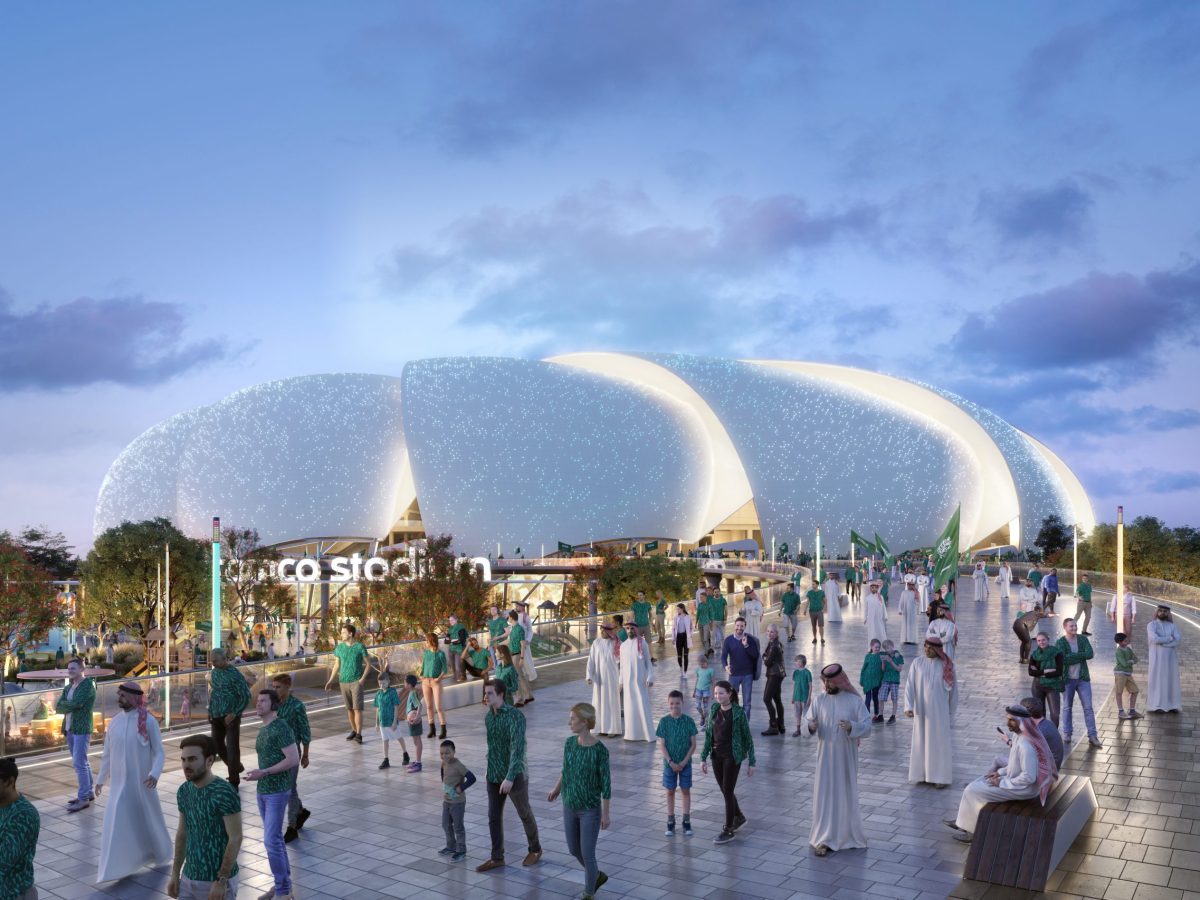
Aramco Stadium public realm and approach in Al Khobar by Populous
The Aramco Stadium approach and public realm are designed as a year-round community destination. Render © Populous.

7. Split mitigation from recovery, and keep a delay chronology

Tournament venues carry both known risks (supply lead times, specialist facade panels) and shock risks (weather, labour, logistics). Teams should keep a recovery plan separate from a mitigation plan, and maintain a delay-event chronology so any slip is documented with cause, effect and responsibility from day one.

8. AI and reporting compress the feedback loop

With a joint-venture contractor and an international design lead feeding the same programme, fast, verified reporting matters. The same principles behind AI in construction planning and connecting Primavera P6 to Power BI apply here: automate the routine, keep a human in the verification loop, and turn schedule rows into a management view the owner can act on.

How Aramco Stadium compares with other Saudi programmes

Aramco Stadium follows the same pattern as other Eastern Province and Red Sea developments: a developer-owner, an international design signature, a tournament or opening date as the critical path, and an operating business case that outlasts the headline event. The Shura Island Red Sea lessons and the AMAALA Triple Bay update show the same disciplines — logistics, phased handover and integrated controls — applied at different scales.

Conclusion

Aramco Stadium construction is a fixed-deadline, tournament-driven build: a 47,000-seat venue owned by ROSHN, operated by Saudi Aramco, designed by Populous and built by BESIX and ALBAWANI, targeting completion in late 2026 and LEED Gold certification. Beyond the architecture, its value to the industry is the delivery model — a clear owner-operator-design-build split, a defended schedule, and a business case that survives the final whistle. For project-controls teams, it is a timely reminder that on mega programmes the plan is only as good as the baseline, the progress measurement and the look-ahead that actually reaches the site.

Sources

Project facts were verified against the official Aramco Stadium construction announcement, the Populous Aramco Stadium showcase, and the Dezeen design release. Render imagery © Populous.

Article Snapshot

Topic: Aramco Stadium construction, design and project controls

Primary keyword: Aramco Stadium construction

Focus: Delivery model, baseline, climate, progress, handover

Brainbay Tools

  • Project Analyzer
  • Schedule Health
  • Compare Schedules
  • Progress & EVM

Project-Control Themes

  • Fixed-date baseline
  • Climate-aware planning
  • Readiness-based progress
  • Interface control

Verified Sources

Official Aramco Stadium, Populous and Dezeen updates were used for project facts.

Updated: 27 Aug 2026

Categories
Uncategorized

Shura Island and Red Sea Construction Lessons: Project Controls for Complex Island Developments

Saudi Giga Projects

Shura Island and Red Sea Construction Lessons

Shura Island construction lessons for complex island developments, phased openings and live hospitality operations.

Shura Island construction lessons for project-controls teams

Shura Island construction lessons are increasingly relevant to planners and project-controls teams working on complex destination projects in Saudi Arabia. At the heart of The Red Sea, Shura combines hotels, residences, a marina, golf, utilities and transport infrastructure on an island where environmental performance is part of the delivery brief—not an afterthought.

Red Sea Global (RSG) says Shura Island is planned for 11 luxury resorts, more than 2,000 hotel keys, 305 residences, an 18-hole island golf course and a marina. Access is via Red Sea International Airport and a 3.3 km over-water crossing. The island is powered by renewable energy, and RSG is targeting a 30% net conservation benefit across its destinations by 2040.

Those headline numbers are impressive, but the more useful question for project teams is: what does this kind of development teach us about planning and controls?

1. Strategic planning must start with systems, not buildings

On a conventional building project, the programme can sometimes be read mainly as a sequence of structural, architectural and MEP activities. An island destination is different. The hotels may be the most visible assets, but they depend on a network of enabling works: marine access, roads, utilities, logistics routes, renewable-energy infrastructure, landscaping, public realm, communications, testing and operational readiness.

This changes how the master schedule should be built. A useful programme must expose the interfaces between infrastructure and vertical assets. If a resort’s internal works are progressing but permanent power, access, back-of-house logistics or commissioning systems are late, the apparent building progress can give management a false sense of security.

  • Structure the WBS around both assets and enabling systems.
  • Show when each hotel can receive permanent utilities.
  • Model logistics-route changes and restricted access periods.
  • Integrate operator possession and handover milestones.

2. Shura Island construction lessons: treat logistics as schedule logic

Shura Island construction lessons show that island logistics must be treated as a production constraint. Materials, specialist equipment, labour and waste movement compete for limited access points and routes. As the destination transitions from construction to operation, those routes become even more constrained because guest experience and safety take priority.

The planning team should therefore model major logistics constraints explicitly rather than hiding them in narrative assumptions. Procurement dates, marine or road delivery windows, laydown availability, lifting access and temporary-route closures can all become predecessors to physical work.

A practical look-ahead should answer three questions: what must arrive, where will it be stored, and what access is required to install it? If any of those answers are uncertain, the activity is not truly ready.

Brainbay Tool Spotlight

Complex island programmes need fast visibility into weak logic, float movement and changing completion paths.

Analyze your Primavera P6 XER file
Review logic, constraints, float and schedule-health issues.

Compare schedule updates
Track milestone movement, driving paths and recovery changes.

Progress & EVM analytics
Connect progress trends with management reporting.

Analyze a Primavera P6 XER file →

3. Shura Island construction lessons for phased openings

Another of the Shura Island construction lessons is the importance of progressive handover. RSG announced the first wave of Shura openings in 2025, while additional resorts continued through 2026. By 9 July 2026, RSG reported five operational Shura hotels with LEED Platinum certification, while six additional resorts were still scheduled to open later in the year.

That means the controls model cannot rely on one final completion milestone. Each operating asset needs its own chain of completion, testing, authority approvals, training, soft-opening readiness and handover. Shared infrastructure must also be sequenced so that construction serving future assets does not disrupt hotels already receiving guests.

The integrated master programme should distinguish construction complete, systems ready, operator access, soft opening and commercial operation.

4. Shura Island construction lessons for sustainability planning

The sustainability side of Shura Island construction lessons is equally important. RSG reported in July 2026 that all five operational hotels on Shura Island had achieved LEED Platinum under LEED v4 BD+C Hospitality. The company also states that the destination is powered entirely by renewable energy and supported by large-scale battery storage.

For project controls, sustainability targets create real schedule activities: material approvals, environmental inspections, commissioning evidence, energy-performance testing, waste records and certification documentation. These deliverables need owners, durations and predecessors.

A common mistake is to treat certification as a close-out paperwork exercise. On projects pursuing demanding environmental standards, the evidence is generated throughout design, procurement and construction. Missing records late in the programme can become a handover risk even when the physical installation is finished.

5. Interface management deserves its own control system

For interface management, Shura Island construction lessons also show the need for clear responsibility across developers, hotel operators, designers, infrastructure contractors, specialist subcontractors, authorities and operational teams. The schedule may show relationships between activities, but it does not automatically explain the commercial or technical responsibility behind each interface.

Maintain an interface register alongside the programme. Each interface should identify the giving party, receiving party, required information or physical condition, planned need date, current forecast and evidence of acceptance. Link high-risk interfaces to schedule milestones where possible.

This makes weekly coordination more productive. Instead of discussing vague blockers, the team can focus on a small number of measurable conditions that control downstream work.

6. Progress measurement must reflect readiness, not just quantity

Large hospitality developments can accumulate impressive installed quantities while critical completion paths remain unresolved. Stone, ceilings, landscaping or FF&E quantities are useful, but they should be paired with milestone and system-based measures.

For example, a hotel floor may be 95% physically complete but not ready for operator inspection because fire alarm integration, access control or final testing remains incomplete. Weighted progress should therefore be supported by commissioning status, room readiness, area handover and critical milestone trends.

Teams can use the Brainbay Project Analyzer to review project data, schedule health, progress and performance, while the broader Brainbay project-controls platform connects schedule analysis, comparisons and EVM workflows.

7. Schedule health matters more as interfaces multiply

Complex programmes are vulnerable to weak logic because planners are under pressure to incorporate frequent changes quickly. Open ends, excessive constraints, long lags and poorly defined relationships can make a schedule appear stable while reducing its forecasting value.

For island and destination programmes, schedule quality reviews should focus on the logic connecting enabling infrastructure to asset completion. Use schedule-health analysis for Primavera P6 XER or Excel data to identify weak logic, constraints and float conditions that deserve review before management relies on the forecast.

Comparing consecutive updates is equally important. Movement in critical milestones, float consumption and changes in driving paths often reveal emerging risk earlier than headline percentage-complete figures.

8. The transition from construction to operations changes the critical path

Late-stage Shura Island construction lessons become clearest once the first hotels open and the project environment changes. Construction teams must protect live operations, guest routes, noise restrictions and finished assets. Work that was previously straightforward can become time-window dependent.

The programme should therefore be re-tested when operations begin. Temporary access may disappear, working hours may change, and commissioning activities may require coordination with hotel teams. These operational constraints can create a new critical path even when the remaining construction scope is smaller.

What Shura tells planning engineers about Saudi giga-project delivery

Shura Island is useful because it shows a destination moving from a construction programme into a live operating environment. The Red Sea EDITION, InterContinental The Red Sea Resort, SLS The Red Sea, Four Seasons Resort and Residences Red Sea at Shura Island, and Miraval The Red Sea were all identified by RSG as operational and LEED Platinum certified by July 2026. RSG said six more Shura resorts were due later in 2026.

The project-controls lesson is not simply that mega-projects need larger schedules. They need better-connected controls: logistics tied to logic, sustainability tied to deliverables, interfaces tied to milestones, progress tied to readiness, and handover tied to operations.

That is the difference between reporting what has happened and forecasting what will happen next.

Practical checklist for similar island developments

  • Build enabling infrastructure and logistics dependencies into the integrated master schedule.
  • Create separate completion and opening milestone chains for each operational asset.
  • Track environmental and certification deliverables from design through close-out.
  • Maintain an interface register linked to schedule need dates.
  • Combine quantity progress with area, system and commissioning readiness.
  • Review schedule health and update-to-update changes regularly.
  • Re-plan access and working constraints as completed areas become operational.

Use project data to find the next constraint

Brainbay is built around this controls mindset. Planning teams can analyze Primavera P6 XER and Excel project files, review schedule health, compare programme versions and monitor progress and EVM indicators. Explore the Brainbay Platform to turn raw schedule data into clearer management decisions.

Sources

Project facts were verified against the official Red Sea Global Shura Island project page, the 9 July 2026 LEED Platinum announcement, the 18 May 2026 Four Seasons opening update, and the 15 September 2025 Shura launch announcement.

Article Snapshot

Topic: Shura Island and Red Sea construction lessons

Primary keyword: Shura Island construction lessons

Focus: Logistics, interfaces, sustainability, handover and project controls

Brainbay Tools

  • Project Analyzer
  • Schedule Health
  • Compare Schedules
  • Progress & EVM

Project-Control Themes

  • Integrated master schedule
  • Phased handover
  • Readiness-based progress
  • Interface control

Verified Sources

Official Red Sea Global project and milestone updates were used for project facts.

Updated: 27 Aug 2026
Categories
Uncategorized

Primavera P6 Planning for Mega Projects: A Practical Project Controls Framework

Primavera P6 planning becomes more demanding as projects grow from a single contract into multi-package programmes with thousands of activities, interfaces, resources and milestone obligations. In Saudi Arabia, that challenge is especially relevant as Vision 2030 continues to feature major developments including Qiddiya, The Red Sea, NEOM, ROSHN and Diriyah. The scheduling software matters, but the quality of the planning system behind it matters more.

Oracle describes Primavera P6 EPPM as a platform for planning, scheduling, resourcing and managing projects and programmes, with CPM scheduling, resource management, multi-project access and integrated cost-and-schedule capabilities. Oracle’s current Version 26 documentation was published in 2026, confirming that P6 remains actively supported for enterprise project controls.

Why Primavera P6 planning matters on mega projects

A mega project is rarely controlled by one neat programme. Design releases, procurement packages, authority approvals, logistics, enabling works, main construction, specialist subcontractors, testing and handover all move at different speeds. A reliable P6 schedule gives those streams a common time model.

The practical value is not the Gantt chart itself. It is the ability to test whether the plan is logically achievable, identify the path driving a milestone, understand float, forecast resource demand and measure movement against an approved baseline. Oracle notes that P6 can schedule multiple projects, coordinate costs, optimize roles and resources, and support what-if analysis. Those capabilities become particularly useful when several contractors share access, information and completion interfaces.

Start with a WBS that reflects how the project will be controlled

The Work Breakdown Structure should make reporting easier, not merely mirror an organizational chart. For a large construction programme, useful WBS levels normally distinguish project or asset, discipline or package, location, phase and major deliverable. The exact hierarchy depends on the contract and reporting requirements.

A good test is simple: can the project team roll the schedule up to the same levels used in progress meetings, cost reports and management dashboards? If not, the WBS may be technically tidy but operationally weak.

Build logic before chasing dates

One of the most common schedule problems is a programme that looks plausible on screen but depends heavily on imposed dates, excessive constraints or missing relationships. The stronger approach is to model how work actually flows. Activities should normally have meaningful predecessors and successors, with relationship types and lags used deliberately rather than as shortcuts.

For example, stone installation cannot be planned simply from a target completion date. The logic may need approved drawings, material approval, procurement, delivery, access clearance, substrate readiness, installation, inspection, snagging and handover. When that chain is modeled properly, a delay to access or approval can be traced through the programme instead of disappearing inside a manually constrained date.

Use durations that come from production assumptions

Durations should be defensible. For repetitive construction work, start with quantity, crew composition, productivity and available working hours. A 20-day activity should mean something operationally: a known quantity divided by an achievable daily output, adjusted for the actual work calendar and constraints.

This also makes recovery planning more credible. If a milestone slips, management can test whether adding crews, changing sequence, extending shifts or opening another workfront will genuinely improve the forecast rather than simply shortening durations in P6.

Calendars and constraints deserve careful control

Calendars influence every calculated date. Mega projects may require different calendars for design offices, factories, marine logistics, site construction, Ramadan working arrangements, night shifts or specific subcontractors. Incorrect calendars can quietly distort float and completion forecasts.

Constraints should also be controlled. Contractual milestones and genuine external restrictions may justify them, but unnecessary constraints can hide the logic that should be driving the schedule. A schedule-health review should therefore examine hard and soft constraints alongside open ends, negative float, excessive lags and unusual duration patterns.

Resource loading turns a sequence into an executable plan

Primavera P6 planning becomes executable only when the resource assumptions are realistic. A logically correct schedule can still be impossible to build if it demands more labour, equipment or workfronts than the project can supply. Resource loading helps expose that gap. Oracle’s current P6 product information highlights demand and capacity planning, role and resource optimization, and graphical analysis of utilization.

For construction teams, the useful question is not whether every activity has a resource assigned. It is whether the resource model is detailed enough to test the critical assumptions. Labour-intensive trades, cranes, hoists, specialist equipment, logistics capacity and constrained access areas often deserve particular attention.

Baseline management is the foundation of meaningful variance

In disciplined Primavera P6 planning, once a programme is approved, the baseline becomes the reference for measuring movement. Updating the baseline every time the forecast changes defeats that purpose. Changes should instead be controlled and documented so the team can distinguish original commitments, approved change and current forecast.

This is where schedule comparison becomes valuable. Movement in milestones, activity dates, durations, relationships and critical paths can reveal what changed between reporting periods. Brainbay’s Project Analyzer is designed to help teams analyze XER or Excel project files for schedule quality, progress, performance and risk, while the broader project controls analysis platform connects schedule health, comparison, progress and EVM workflows.

Turn the monthly update into a control cycle

Monthly Primavera P6 planning is more than entering actual dates and pressing F9. Oracle’s 2026 scheduling guidance emphasizes scheduling projects to track activities, actual durations and costs so teams can make decisions and predictions. In practice, the update cycle should include a disciplined data date, verified actual starts and finishes, remaining-duration review, logic checks, critical-path review, milestone variance and narrative explanation.

The planner should then challenge the result. Did the critical path change? Is negative float increasing? Are near-critical paths converging on the same milestone? Did a supposedly completed predecessor actually release the workfront? Are forecast dates supported by current production rates?

A practical monthly P6 control workflow

  1. Freeze and archive the previous accepted update.
  2. Collect verified progress and actual dates from responsible teams.
  3. Update remaining durations using current production evidence.
  4. Review new activities, logic changes and approved scope changes.
  5. Run the schedule using agreed calculation options.
  6. Check critical and near-critical paths, float, constraints and open ends.
  7. Compare the update against the baseline and previous period.
  8. Reconcile schedule progress with cost, quantity and site evidence.
  9. Prepare management actions, not just charts.

Connect P6 with progress, cost and dashboards

Primavera P6 planning becomes more useful when schedule information is connected with the rest of project controls. Oracle states that integrated cost and schedule management can improve budget and forecast accuracy, track progress, show the effects of changes and support cash-flow visibility. That principle applies even when teams use separate systems: the activity and WBS structure should still support consistent mapping.

For management reporting, raw schedule tables are rarely enough. Exported P6 data can feed Excel or Power BI to visualize milestone movement, planned versus actual progress, float distribution, critical activities and performance by WBS. Brainbay’s Platform currently provides Project Analyzer, Schedule Health, Compare Schedules and Progress & EVM workflows, with PDF, Excel, Power BI and PowerPoint-oriented outputs.

Schedule health should be reviewed before the report is trusted

Every reporting cycle should include a quality gate. At minimum, review missing logic, excessive constraints, long durations, unusual lags, negative float, invalid actual/forecast combinations, calendar inconsistencies and out-of-sequence progress. The goal is not to achieve a cosmetic score. It is to make sure the schedule behaves predictably when circumstances change.

This is particularly important on large programmes because one weak interface can distort several downstream packages. A small logic error at a design or access milestone may propagate through procurement and construction, creating a forecast that looks precise but is not reliable.

What strong Primavera P6 planning looks like

Strong Primavera P6 planning is a combination of software discipline and construction judgment. The schedule should explain the work, reflect real constraints, use defensible durations, expose interfaces and produce forecasts that site and management teams can challenge.

Saudi Arabia’s large Vision 2030 project environment reinforces the need for this discipline. As programmes become more interconnected, planners add value by turning thousands of activities into a coherent decision model rather than simply maintaining dates.

Ready to review your own programme? Explore the Brainbay project controls platform or analyze your Primavera P6 XER file to examine schedule health, logic, progress and performance.

References

Oracle Primavera P6 EPPM · Oracle Primavera P6 EPPM Version 26 documentation · Saudi Vision 2030